
Concrete Driveway Installation in Racine, WI: What Goes Into a Long-Lasting Driveway?
A driveway in Racine has to handle more than daily vehicle traffic. Winter freezing, spring thawing, rain, snow, deicing materials, and changing temperatures can all expose weaknesses in concrete that was poorly prepared, placed, or cured.
A long-lasting concrete driveway starts below the finished surface. Proper site preparation, a stable and well-compacted base, suitable concrete for Wisconsin conditions, drainage, correctly placed joints, careful finishing, and adequate curing all contribute to durability. Cutting corners during installation can lead to cracking, settlement, surface deterioration, and drainage problems years earlier than expected.
What local homeowners should know
-
The base beneath a driveway matters because concrete performs best when it has uniform, stable support.
-
Racine’s winter conditions make freeze-thaw durability an especially important consideration when selecting and placing exterior concrete.
-
Water should drain away from the driveway rather than collecting along slabs, garage entrances, or low areas.
-
Control joints help manage where normal concrete shrinkage cracking occurs.
-
Curing is part of installation, not an optional step after the concrete has been poured.
Why Does Driveway Construction Matter So Much in Racine?
Driveway construction matters in Racine because exterior concrete must withstand repeated exposure to moisture, freezing temperatures, thawing, and seasonal temperature changes while continuing to support vehicle loads.
National Weather Service observations for Racine demonstrate the temperature swings local concrete can experience. February 2026, for example, included temperatures ranging from 6°F to 63°F. The University of Wisconsin’s Recycled Materials Resource Center also identifies resistance to freezing, thawing, and deicing chemicals as important durability considerations for concrete pavement.
That environment makes the entire installation process important, from excavation through curing. A driveway near Lake Michigan, West Racine, Uptown, or another part of the community still needs a system designed around stable support and water management.
At Langenfeld Masonry & Concrete, we approach driveway installation with those long-term performance factors in mind. Our goal is to help property owners understand what is underneath and within a concrete driveway, not just what they see at the surface.
What Goes Into the Base of a Long-Lasting Concrete Driveway?
The base of a long-lasting concrete driveway begins with removing unsuitable material, establishing a stable subgrade, placing appropriate base material, and compacting it so the slab receives consistent support.
Concrete is strong, but unsupported sections can become vulnerable when the soil or base underneath moves or settles. Proper preparation is particularly important where water can infiltrate the surrounding ground and seasonal freezing can affect conditions beneath the slab.
The driveway also needs to be planned around the property’s existing elevations. Water flowing toward a garage, collecting beside the driveway, or repeatedly entering the base can create avoidable problems.
What Local Conditions Affect Concrete Driveways?
Local conditions affect concrete driveways primarily through freeze-thaw cycles, moisture, deicing exposure, drainage, and the changing temperatures southeastern Wisconsin experiences throughout the year.
Racine sits directly along Lake Michigan and includes everything from older established neighborhoods to newer residential development extending toward Mount Pleasant and surrounding communities. City planning documents identify areas and destinations including Downtown Racine, Uptown, West Racine, Root River, North Beach, and nearby communities such as Caledonia and Wind Point.
Although individual properties vary, every driveway needs to account for its specific grade, drainage, soil conditions, expected traffic, and connection points.
What Are the Warning Signs of a Failing Driveway?
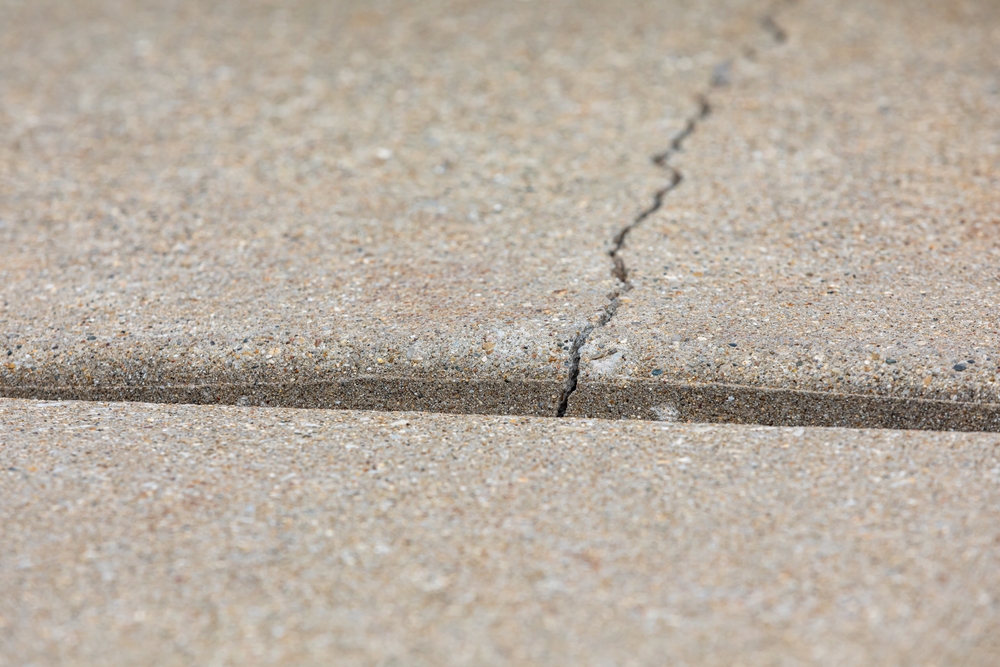
The warning signs of a failing driveway include widening cracks, uneven slabs, recurring standing water, surface deterioration, sinking sections, damaged edges, and movement where the driveway meets a garage or sidewalk.
Homeowners should watch for:
-
Cracks that become wider or change noticeably over time.
-
Slabs that have settled and created uneven transitions.
-
Water that repeatedly pools after rain or snowmelt.
-
Flaking, scaling, or deterioration across the concrete surface.
-
Broken or crumbling slab edges.
-
Low spots that direct water toward the garage.
-
Sections that rock, shift, or appear unsupported.
-
Extensive previous patching that continues to fail.
One small crack does not automatically mean an entire driveway requires replacement. Multiple structural or drainage problems, however, can indicate that the issue extends beyond the surface.
When Should You Call a Concrete Professional?
You should call a concrete professional when cracking, settlement, drainage problems, or widespread deterioration makes it difficult to determine whether repair or replacement is the better long-term approach.
Homeowners can safely monitor minor surface changes and keep the driveway clear of debris that interferes with drainage. Structural movement, significant settlement, extensive deterioration, and decisions involving removal and replacement are better evaluated professionally.
In Racine County, that evaluation is especially useful before another winter adds moisture and freezing conditions to an already compromised driveway.
What Commonly Causes Concrete Driveway Problems?
Concrete driveway problems commonly result from inadequate base preparation, poor drainage, freeze-thaw exposure, improper joint planning, unsuitable installation practices, or a combination of these factors.
1. Weak or inconsistent support: If the material underneath the slab settles unevenly, the concrete above can lose support and crack.
2. Water problems: Poor grading can allow water to collect around or beneath portions of a driveway.
3. Freeze-thaw exposure: Water and freezing temperatures can be hard on exterior concrete, which is why concrete intended for Wisconsin conditions must account for this environment.
4. Poor joint planning: Concrete naturally shrinks as it hardens. Properly planned joints help control where cracking occurs.
5. Inadequate curing: Fresh concrete needs time and appropriate conditions to develop its intended properties.
How Can Homeowners Maintain a Concrete Driveway?
Homeowners can maintain a concrete driveway by controlling water, limiting damaging winter practices, monitoring cracks and joints, and addressing developing problems before deterioration spreads.
Check the driveway during spring after winter conditions have passed. Look for new cracks, settlement, drainage changes, or surface damage. During summer and fall, make sure surrounding landscaping and drainage patterns are not directing unnecessary water onto or beneath the slab.
Before winter, inspect areas where water tends to collect. Snow and ice management also deserves care because exterior concrete in southeastern Wisconsin faces both moisture and deicing exposure.
DIY maintenance should stop when a problem appears structural rather than cosmetic.
What Results Should You Expect From a New Concrete Driveway?
A properly installed new concrete driveway should provide a stable, functional surface with intentional drainage, planned joints, consistent finishing, and construction choices suited to local exposure.
Concrete is not a crack-proof material. Normal shrinkage and movement are part of concrete behavior, which is why joint layout, base preparation, placement, and curing matter so much.
The objective is not to promise that concrete will never change. It is to build the driveway correctly so it has the conditions needed for long-term performance.
What Driveway Installation Mistakes Should Racine Homeowners Avoid?
The biggest driveway installation mistakes are focusing only on appearance, overlooking drainage and base preparation, and treating curing or joint placement as minor details.
Mistake: Choosing based only on the finished surface.
Consequence: Important preparation underneath the concrete may receive too little attention.
Better approach: Ask how excavation, base preparation, grading, joints, placement, and curing will be handled.
Mistake: Ignoring water flow.
Consequence: Water may collect in inconvenient or damaging locations.
Better approach: Consider drainage before concrete placement establishes the final elevations.
Mistake: Expecting concrete never to crack.
Consequence: Homeowners may misunderstand the purpose of control joints.
Better approach: Focus on sound installation practices that manage normal concrete behavior.
What Is a Common Racine Driveway Scenario?
A common Racine driveway scenario is an older slab with several cracks, one or more settled areas, and water collecting in low spots after rainfall or melting snow.
In that situation, repeatedly patching the visible cracks may not address the underlying cause. If the base has settled or the existing grade directs water poorly, replacement provides an opportunity to evaluate those conditions before new concrete is installed.
This is a representative local scenario, not a specific customer project.
What Services Help Solve Driveway Problems?
Concrete driveway replacement and installation help solve widespread cracking, settlement, poor surface condition, and layout problems when an existing driveway has reached the point where isolated repairs are no longer practical.
A professional installation can address the entire system, including removal where necessary, site preparation, base conditions, grading, concrete placement, joints, finishing, and curing considerations.
Should You Repair or Replace Your Concrete Driveway?
Repair is generally more appropriate for limited, isolated problems, while replacement becomes more practical when deterioration, settlement, or drainage issues affect significant portions of the driveway.
A small localized defect may not justify removing otherwise serviceable concrete. By comparison, numerous cracks, widespread surface failure, multiple settled slabs, or recurring drainage problems can make repeated repairs a short-term strategy.
The right choice depends on what is causing the damage, not simply how the surface looks.
What Areas Around Racine Can Homeowners Consider These Driveway Solutions?
Homeowners throughout Racine and nearby Racine County communities can benefit from evaluating driveway condition with southeastern Wisconsin’s climate in mind.
That includes properties around West Racine, Uptown, the Root River area, and nearby communities such as Mount Pleasant, Caledonia, Sturtevant, Wind Point, and North Bay. These are communities identified within the broader local area by City of Racine planning materials.
What Can Happen If You Ignore a Deteriorating Driveway?
Ignoring a deteriorating driveway can allow cracks, settlement, drainage issues, and surface damage to become more extensive, particularly when moisture repeatedly reaches vulnerable areas before winter freezing.
Waiting does not mean every driveway will suddenly fail. The practical concern is that a localized problem may become harder to address economically once movement or deterioration spreads across multiple sections.
FAQ
How long should a concrete driveway last in Racine, WI?
A concrete driveway’s useful life depends heavily on installation quality, site conditions, drainage, traffic, maintenance, and winter exposure. Rather than relying on a single lifespan estimate, Racine homeowners should focus on proper base preparation, suitable concrete, joint planning, curing, and water management to support long-term performance.
Why are freeze-thaw cycles important for concrete in Racine?
Freeze-thaw cycles matter because moisture within or around concrete can freeze and expand as temperatures drop. Southeastern Wisconsin experiences regular winter freezing as well as periods when temperatures rise again. Concrete materials and installation practices therefore need to be appropriate for exterior freeze-thaw exposure.
Does a concrete driveway need control joints?
Yes. Control joints are intentionally incorporated to help manage cracking caused by normal concrete shrinkage. Their spacing and layout should be planned as part of the driveway rather than treated as an afterthought. They cannot guarantee a crack-free driveway, but they play an important role in controlling concrete behavior.
Why is drainage important for Racine concrete driveways?
Drainage is important because standing or poorly directed water can contribute to problems around slabs, edges, garages, and the underlying base. In Racine, rainfall, snow, melting ice, and winter freezing make water management a year-round concern. Driveway elevations should be considered carefully before concrete is placed.
Can a badly cracked driveway simply be resurfaced?
Not always. Surface work may improve appearance, but it does not automatically correct settlement, unstable support, significant slab movement, or poor drainage beneath an existing driveway. If cracks reflect deeper problems, a professional evaluation can help determine whether repair or complete replacement is the more appropriate option.
When is the best time to inspect a driveway in Racine County?
Spring is an especially useful time to inspect a driveway because homeowners can see how the concrete came through winter conditions. Look for new cracks, settlement, scaling, damaged edges, and drainage changes. Fall is another useful checkpoint for addressing obvious concerns before freezing temperatures return.
Should I replace my driveway before selling a home in Racine?
Replacement may make sense when the driveway has extensive cracking, settlement, poor drainage, or significant deterioration, but it is not automatically necessary before every home sale. Property owners should consider the driveway’s condition, function, appearance, and the extent of any underlying problems before deciding.
What should I ask a concrete contractor about driveway installation?
Ask about site preparation, base material and compaction, drainage, concrete selection, slab design, joint placement, finishing, curing, and how existing structures or elevations affect the project. For a driveway in southeastern Wisconsin, it is also reasonable to ask how the installation accounts for local freeze-thaw exposure.
Build Your Driveway for Racine Conditions
A durable driveway is the result of what happens before, during, and after the concrete placement. From the base and drainage to joints and curing, each step helps prepare the finished surface for years of southeastern Wisconsin weather.
For homeowners considering concrete driveway installation in Racine, we can help evaluate the existing driveway and discuss options based on the property.
Get a Concrete Driveway Built for Your Property and Local Conditions
We will help you understand the installation process and the factors that matter for long-term performance.
Categorised in: Concrete Driveways